Selecting a medium frequency induction heating machine should begin with the workpiece and production target rather than with a preferred power rating. Workpiece diameter, heated length, material, target temperature, heating depth, and cycle time determine how much useful energy must reach the part. Frequency then affects where that energy is concentrated. A correctly selected system brings the required section to temperature within the available cycle time while maintaining acceptable temperature uniformity and sufficient operating margin for continuous production.
What Information Is Needed Before Choosing an Induction Heating Machine?
The first step is to define the heating task in measurable terms. A supplier needs to understand the metal material, workpiece dimensions, weight, starting temperature, target temperature, length of the heated zone, required heating time, and expected hourly output.
These details matter because two workpieces with similar outside dimensions may impose very different thermal loads. A solid steel bar that must be heated through its entire cross-section requires a different heating strategy from a hollow tube that only needs localized heating around one end.
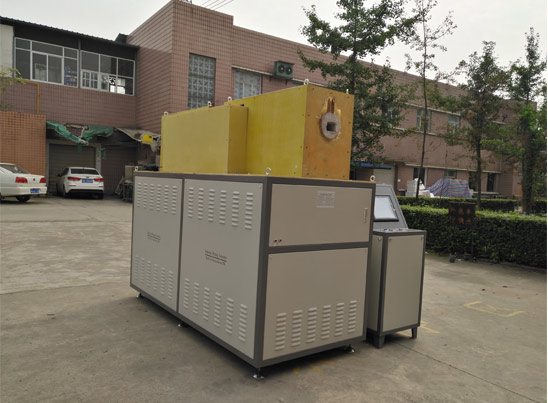
When evaluating medium frequency induction heating equipment, the key is to determine how much material must be heated during each cycle, how deeply the heat needs to penetrate, and how quickly the next part must enter the coil. These variables provide a much more reliable sizing basis than part diameter or generator kW alone.
How Do You Estimate the Required Heating Power?
The thermal demand is mainly influenced by workpiece mass, specific heat, temperature rise, and heating time. If the same workpiece must reach the same temperature in half the time, the required useful heating power will increase significantly.
Theoretical thermal energy, however, is not the same as the final generator rating. Electrical conversion losses, coil coupling, part positioning, frequency selection, and heat loss to the environment reduce the amount of generator power that becomes useful heat in the workpiece.
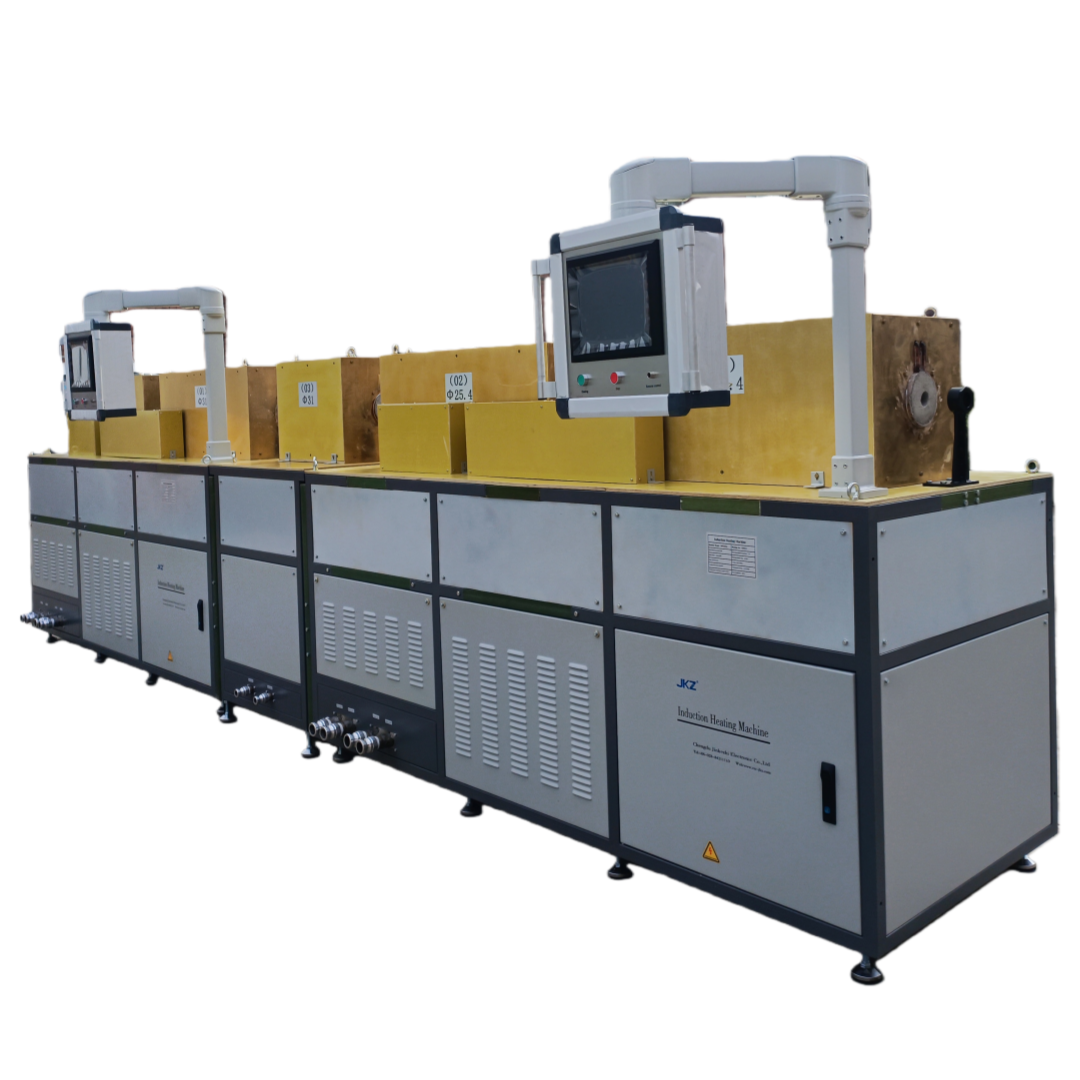
| Sizing Input | Influence on Machine Selection |
|---|
| Workpiece mass | More mass requires more thermal energy |
| Temperature rise | A higher target temperature increases energy demand |
| Heating time | Shorter cycles generally require greater usable power |
| Heated length | A longer heated zone increases the total load |
| Material properties | Affect electromagnetic coupling and heating response |
| Coil clearance | Excessive clearance reduces effective energy transfer |
| Production rate | Determines practical cycle and duty requirements |
For this reason, a trial in which one part reaches temperature successfully does not prove that the machine is correctly sized for continuous production. The system must maintain the same result throughout the intended duty cycle.
How Does Frequency Affect Heating Depth?
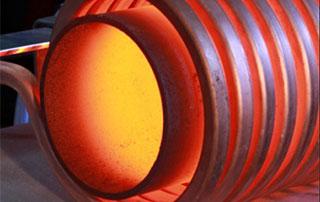
Frequency has a direct relationship with the distribution of induced current in the workpiece. Higher frequencies generally concentrate heating closer to the surface, while lower frequencies allow energy to penetrate farther into the material.
For thick steel bars, large shafts, billets, and other workpieces that require substantial through-heating, medium-frequency operation can therefore be more suitable than very high-frequency heating.
Correct induction heating frequency selection should consider both workpiece diameter and the required temperature profile.
If the frequency is too high for a thick cross-section, the outside of the workpiece can reach the target temperature well before the center. Simply increasing power may then create a larger surface-to-core temperature difference instead of improving the process.
The objective is to find a frequency range that provides sufficient heating depth while still allowing the required production rate.
Why Does Coil Design Change the Required Machine Size?
The induction coil determines how effectively generator power is transferred into the workpiece.
Coil diameter, number of turns, conductor shape, coupling distance, heated length, and workpiece position all influence the electromagnetic field. A poorly designed coil can make a sufficiently powerful generator appear underpowered because too little energy is being delivered to the intended heating zone.
This becomes especially important in automated production. If workpiece positioning varies between cycles, the coil-to-part relationship also changes. Even a small positional difference can influence the heating rate and temperature distribution.
Machine sizing and coil design should therefore be treated as one engineering task. A larger power supply should not be used as a substitute for poor coil coupling.
How Should the Production Target Influence Machine Selection?
The required output should be expressed as pieces per hour, kilograms per hour, or a defined takt time.
If a billet requires 18 seconds of active heating but loading, unloading, and transfer require another 12 seconds, the actual cycle is approximately 30 seconds. The production system can therefore achieve about 120 cycles per hour before allowing for interruptions.
For applications using an induction heater for forging, the heating station must also be synchronized with the forging press. Producing hot billets faster than the downstream press can process them can create waiting time, scaling, temperature variation, and unnecessary energy consumption.
This is why the highest-power machine does not necessarily produce the highest usable output. Production efficiency depends on the complete line.
How Much Power Margin Is Reasonable?
An industrial induction system should have enough margin to accommodate normal variation in starting temperature, workpiece size, surface condition, coil wear, and production speed.
Too little reserve capacity may force the system to operate continuously near its maximum output. That leaves little room for changes in load or future increases in production rate.
Excessive oversizing is also undesirable. A much larger machine may increase purchase cost without improving the process, especially when heating speed is limited by heat conduction through the workpiece rather than available generator power.
The practical approach is to define the normal operating point and then select enough reserve capacity for realistic production variation.
Why Does the Power Supply Matter Beyond the kW Rating?
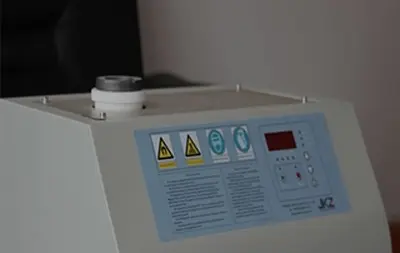
Modern induction heating power supplies should be evaluated for controllability and continuous-duty performance as well as nominal output.
The system needs to maintain stable power under changing loads and reproduce the same heating recipe repeatedly. Cooling capacity is also important because high production rates increase the thermal load on the power supply, capacitor system, induction coil, cables, and cooling circuit.
A machine that performs well during a short demonstration may not be suitable for continuous multi-shift production if the cooling system cannot maintain stable operating conditions.
What Information Should Be Sent to the Equipment Supplier?
An accurate machine recommendation should be based on a workpiece drawing or clear dimensions, material grade, minimum and maximum part weight, heated zone, starting and final temperature, required heating depth, target heating time, hourly output, loading method, available voltage, and expected operating hours.
If the new machine must connect with an existing forging press, conveyor, robot, or transfer mechanism, that information should also be included. In many projects, production integration influences the final machine configuration just as much as the heating requirement itself.
Conclusion
Sizing a medium frequency induction heating machine is not simply a question of choosing enough kW to make the workpiece hot. The correct machine must combine appropriate power, frequency, coil geometry, cooling capacity, and cycle design. When the selection is based on the real thermal load and production rhythm, the system can achieve more consistent heating without unnecessary oversizing or excessive surface temperature.
FAQ
1. How do I know whether medium frequency is suitable for my workpiece?
Medium frequency is generally worth evaluating when the workpiece has a relatively large cross-section or requires deeper heating. The final choice should still be based on material, diameter, heating depth, and cycle time rather than frequency range alone.
2. Does a larger induction heating machine always heat faster?
No. Once heating becomes limited by heat transfer inside the workpiece, additional power may increase the surface temperature without producing a proportional improvement at the core. Coil design and frequency can be as important as generator power.
3. Can one medium frequency machine heat different workpiece sizes?
It can be possible when the parts fall within a reasonable operating range, but different coils or process recipes may be required. Large differences in diameter, heated length, or material should be evaluated separately before one power supply is selected for all parts.
 en
en  cn
cn  jp
jp  ko
ko  de
de  es
es  it
it  ru
ru  pt
pt  th
th  vi
vi  pl
pl 




 Call us on:
  Email Us:
  NO. 688th South Baoguang Road, Xindu District, Chengdu City, Sichuan Province, China